
Do Public Schools Need Choking Rescue Devices? 2026–2027 Guide to State Requirements
Whether a public school must stock a choking rescue device depends on its state. Rules in this area have been changing, so the first step is to confirm the current requirement with your state department of education or legislature. Many schools also add a non-invasive airway clearance device as a backup for when standard choking first aid fails or cannot be performed. The device works alongside trained staff and a 911 call. It never replaces them.
Why are public schools being asked to stock choking rescue devices?
Schools serve food to large numbers of children every day, often in crowded cafeterias with short lunch periods. Choking can happen in classrooms, on field trips, at sports events and during after-school programs, as well as at lunch. Staff are trained to call 911 and perform standard choking first aid. Policymakers, school nurses and parent groups have increasingly asked a further question: what is the backup plan if those maneuvers don't work or can't be performed?
That gap is what non-invasive airway clearance devices are designed to address. These are manually operated suction devices with a face mask. They are meant for use only after standard first aid has been tried or when it cannot be done. Examples include a student in a wheelchair, a person who is much larger than the rescuer, or someone who is alone.
A device does not change the basic emergency plan:
- Call 911 first (or have someone else call).
- Follow standard choking first aid as trained.
- Use an airway clearance device only as a backup, according to the manufacturer's instructions.
- Get professional medical care afterward.

Is there a law requiring choking rescue devices in schools?
There is no single answer that applies to every school. State legislatures have been considering requirements for non-invasive airway clearance devices in schools. Bills move through very different stages, and the stage matters:
- Proposed: introduced but not yet passed. There is no requirement yet.
- Passed but not yet effective: a deadline exists, often tied to a school year.
- Effective: schools are expected to comply.
- Passed with or without funding: some laws come with state money, and others leave purchasing to districts.
Because this changes from session to session, rely on your state's official sources rather than any summary article, including this one. Statutes, effective dates and definitions are worded differently in each state.
Which states have passed or proposed mandates?
We don't publish a state-by-state list. It would go out of date quickly, and a wrong date could cause a district to miss a real deadline. Here is how to get an accurate answer for your state in about 20 minutes:
- Search your state legislature's bill tracker for terms like "airway clearance device," "anti-choking device," "choking rescue device" and "school."
- Check your state department of education's health services or school nursing guidance pages.
- Ask your district's school nurse coordinator or risk manager. They usually track new health-equipment requirements.
- Contact your state school nurse association. These groups often summarize new laws for members.
- Read the exact wording. Note which device types qualify, where devices must be kept, how many are required, and whether staff training is mandated.
If your state has no requirement, the decision belongs to your district. Many districts weigh it the same way they weigh other optional emergency equipment.
What are schools typically required to have on-site?
Where a requirement exists, the details come from the statute or the state's implementing guidance. When a school plans its rollout, these are the questions it most often has to answer:
- Device type: whether the law specifies "non-invasive" devices and any regulatory status the device must have.
- Quantity and placement: one per building, per cafeteria, per floor, or alongside the AED.
- Mask sizes: coverage for both children and adults, since schools serve students and staff.
- Training: who must be trained, how often, and whether training must be documented.
- Storage and inspection: where devices are kept and who checks them.
- Emergency action plan updates: where the device fits in your written choking response procedure.

How do common options compare for a school setting?
Schools generally choose between three approaches: a device from one manufacturer, a device from another manufacturer, or training-only (no device). The table below uses only published details from each company.
| What schools ask | ArixMed® Choking Rescue Device | LifeVac | Training only, no device |
|---|---|---|---|
| Listed price | $49.99 | $69.99 per unit starting October 7, 2026 | No equipment cost |
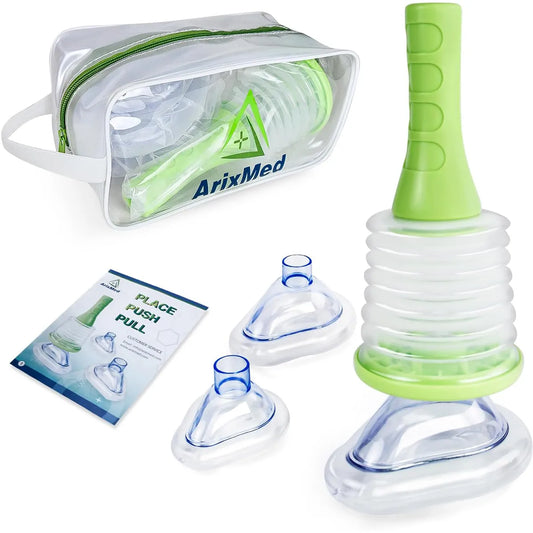
| What's included | 1 manual suction device, 2 adult masks (1 emergency, 1 practice), 1 child mask, printed practice manual, clear zippered storage bag | Check manufacturer listing | N/A |
| Regulatory statement published | Ask the manufacturer for documentation your state requires | FDA Registered for safety and quality | N/A |
| Shipping | Free shipping; processed in 1–2 business days; most arrive in 3–5 days; US only | Free shipping; processed in 1–2 business days; standard delivery 5–7 business days | N/A |
| Returns | 30 days; unused, original packaging | 30-day money-back guarantee; unused, original packaging | N/A |
| Replacement after a rescue | Free replacement if used to save someone | Free lifetime replacement if used in a choking emergency | N/A |
| Meets a device mandate? | Check your state's wording | Check your state's wording | No, if your state requires a device |
If your state's law requires a specific regulatory status, such as FDA registration, ask every vendor for written documentation before purchasing. Choose the product that clearly meets the statute's wording.
Where does ArixMed fit in a school's plan?
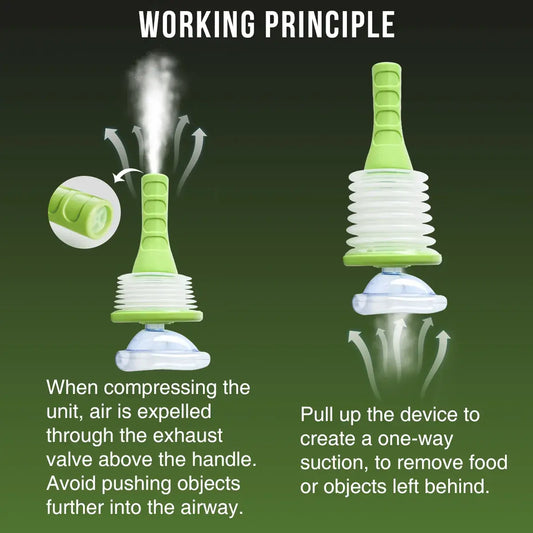
The ArixMed® Choking Rescue Device for Kids and Adults is a non-invasive, manually operated suction device. Its push-and-pull mechanism creates negative pressure to help dislodge a suspected airway obstruction. A double one-way and exhaust valve design pushes air away from the mask during compression and creates suction during the pull.
Several of its features suit school use:
- Kid and adult masks in one kit. Each kit includes one child mask and two adult masks, which covers students and staff.
- A built-in practice option. One adult mask is for emergencies and one is for practice. Staff should practice only with the practice mask before an emergency.
- Easy storage. Everything fits in a clear zippered bag, so it can sit with the AED or in the nurse's office. Store it in a cool, dry place with the masks and instructions together.
- Reusable. Assign someone to check mask condition on a regular schedule.
- Listed for school use. The manufacturer lists school among its intended settings, along with home, travel, restaurants and senior care.
The device also has limits. It is meant for use only when standard choking first aid has failed or cannot be performed, and only according to the current instructions for use. It does not replace first-aid training, CPR training, emergency medical services or professional care.
A district that needs a particular regulatory designation should request that documentation from ArixMed before buying (service@arixmed.com).
Steps for schools to get compliant
- Confirm the requirement. Pull the statute or guidance for your state and write down the effective date, device criteria, quantity and training rules.
- Map placement. List the cafeteria, gym, nurse's office, front office, buses and field-trip kits. Placing devices near the AEDs makes them easier to find.
- Choose a device that matches the law's wording. Collect vendor documentation and keep it on file.
- Order with lead time. Allow for processing, delivery and receiving at the district warehouse.
- Train staff. Combine standard choking first aid and CPR training with hands-on practice using a designated practice mask.
- Update your emergency action plan. State clearly that the device is a backup step after 911 and standard maneuvers.
- Set an inspection routine. Add device and mask checks to your monthly AED or first-aid kit checklist.
- Document everything. Keep purchase records, placement maps and training logs for audits.

Funding and grant options for schools
At $49.99 per kit, the ArixMed device is a small line item for one school. A district equipping many buildings, buses and trip kits will still need a budget plan. Common sources include:
- State funding attached to the law. Some health-equipment mandates include appropriations or reimbursement, so check the bill text.
- District health services or safety budgets. These often cover AEDs and first-aid supplies.
- School safety or student wellness grants offered by state agencies.
- PTA/PTO fundraising. Parent groups often fund cafeteria and nurse's office equipment.
- Local community foundations, hospitals and service clubs. These groups sometimes sponsor emergency equipment for schools in their area.
- Booster clubs for athletics and activity buses.
When you apply, describe the request as part of a complete choking response plan that includes equipment, training and protocol updates. Funders generally respond better to that than to a request for equipment alone.
The bottom line
Whether a school needs a choking rescue device depends on its state, and the only reliable source is the current statute or state guidance. Whether a school should have one is a planning decision that many districts are making either way. If you add a device, treat it as a backup tool inside a trained, documented emergency response that always starts with calling 911. Stay Ready, Save a Life!
FAQ
Do all public schools have to have a choking rescue device?
It depends on your state. Requirements vary and are changing, so check your state legislature's bill tracker and department of education guidance for the current rule and effective date.
Does a choking rescue device replace the Heimlich maneuver or CPR training?
No. The ArixMed device is meant for use only when standard choking first aid fails or cannot be performed. It does not replace first-aid training, CPR training or emergency medical services.
Can one device be used on both students and staff?
The ArixMed kit includes one child mask and two adult masks (one for emergencies, one for practice), so a single kit covers kids and adults.
How should schools store a choking rescue device?
Keep it in a cool, dry place with the masks and instructions together, ideally near the AED. Check mask condition on a regular schedule.
How can staff practice without using the emergency mask?
The ArixMed kit includes a designated practice mask and a printed practice manual. Practice only with the practice mask, and keep the emergency mask ready.
What if our state law requires a specific regulatory status?
Read the statute's exact wording, ask each vendor for written documentation, and choose a device that clearly meets it.